Description
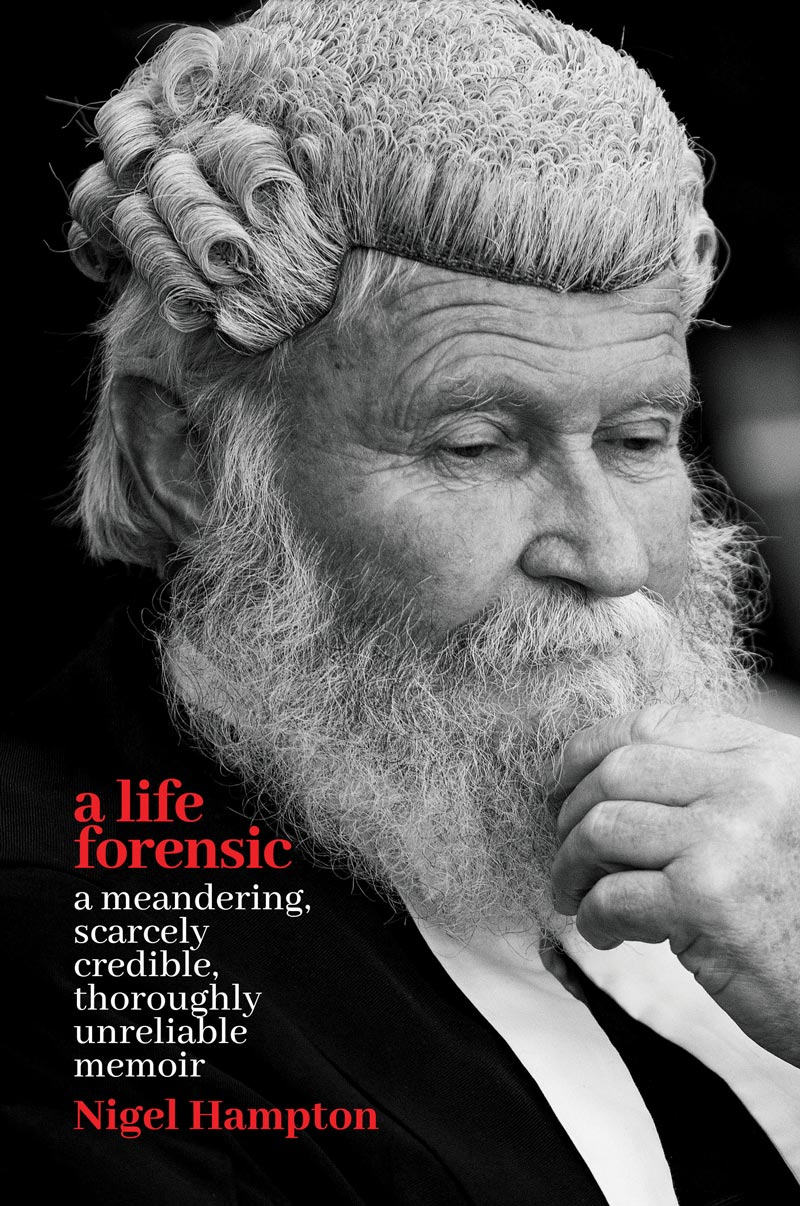
What do the David Bain murder trials, Peter Ellis trials, the CTV collapse, Pike River and the Christchurch mosque shooting have in common? They share the needle-sharp legal mind of Nigel Hampton OBE, KC, who has witnessed and helped shape
some of New Zealand’s most significant cases, and has seen and influenced major changes in the legal profession itself. In this compelling, highly readable and often humorous memoir, he describes the moments, the relationships and the language that have affected his life, the ‘adrenalin tidal surges of the criminal trial’, the importance of the dramatic flourish, and the disillusionment and exhaustion that at times have accompanied his quest for justice.
After more than six decades in law, consummate storyteller Nigel Hampton offers a forensic examination of a career ‘striving to achieve right, correcting wrongs, through the law’. His tale, at first glance chaotic, with every deft twist and turn reveals the heart, humour and acuity of one of New Zealand’s most respected defence lawyers. Underpinning his story is a clear thread: a conviction that the law matters most when it improves lives and strengthens justice.
From a colourful youth in Canterbury to the mud of the rugby field and the panelled walls of courtrooms, a two-year stint as Chief Justice in the Kingdom of Tonga and a spell as commissioner with the International Criminal Court in The Hague, Nigel Hampton’s engrossing account is, as he says, ‘digressive, even divergent, yet always relevant’.
A Life Forensic describes a life and career in which language, oratorical skill and ‘the promptings of humanity’ are writ large.
About the Author
As one of this country’s leading criminal defence lawyers, Nigel Hampton KC has had some 60 (and more) years working in New Zealand courts at all levels, up and down the land. He has acted in many scores of homicide cases as well as many other jury trials, both civil and criminal.
Doing that sort of work at that level, saw him advanced to the most senior rank of courtroom lawyers in 1989 (Queen’s Counsel, now King’s Counsel) and projected him on to the national stage from an early time in his career. This led him to a variety of legal posts and appointments, including: in leading roles in Law Societies and Bar Associations; in Legal Aid bodies; in Criminal Law Reform bodies both national and international; in lawyers disciplinary bodies again both nationally and internationally (including at the International Criminal Court); in New Zealand’s miscarriage of justice commission (the CCRC); and as Chief Justice of the Kingdom of Tonga.
Immediately following the disastrous events in New Zealand in 2010 (Pike River Mine explosion) and 2011 (the fatal Christchurch earthquakes), he was enmeshed in various forms of advocacy and litigation on behalf of those most affected by those catastrophic events, namely the families of those killed in the mine (29 boys and men) and the families of those killed in the collapsed CTV building (115 persons from a variety of countries).
Almost inevitably, Hampton was to become involved in acting for a number of the families of those killed in the Christchurch Mosque massacres of 2019, as well as some of the wounded survivors.
And, as he himself has observed, his legal world of “traditional” homicides (murder and manslaughter) tried in criminal courts, in the last 15 years or so, has become a world of
industrial scale homicide more often “tried” in the court of public opinion.
For balance in his own life, Hampton writes of his involvement in rugby, of his and his family’s beloved sanctuary of Kawatea/Okains Bay on Banks Peninsula and of sailing and floundering and other fishing (including a tangle with a stingray, the ray winning easily); and of the extraordinary Museum in that Bay.
Once described as caring too much (about people that is) to be seen as safe as a judge, Hampton has always held to the belief that the law, necessarily, should be driven by the promptings of humanity and that the individual human being must be the ultimate focus of the law, even in the midst of catastrophic mass deaths and destruction. Which serves to underline for him, the need for continual vigilance to ensure that the rule of law is respected and observed both nationally and internationally, a proposition under malignant attack in recent times.
For services to the law, he was awarded an OBE in 1988 and a CNZM in 2018. Perhaps reflecting recognition of a life lived striving to achieve right and to correct wrongs through the law, led by, impelled by, his moral scruples and ethical responsibilities.
It is that life which he now forensically examines for the reader.
Specifications
ISBN: 978-1-997375-02-9
Pages: 256 pages (incl. 3 x 8pp photo inserts)
Dimensions: 229mm x 152mm (Portrait)
Format: Limpbound
Author: Nigel Hampton
Published: 16 November 2026